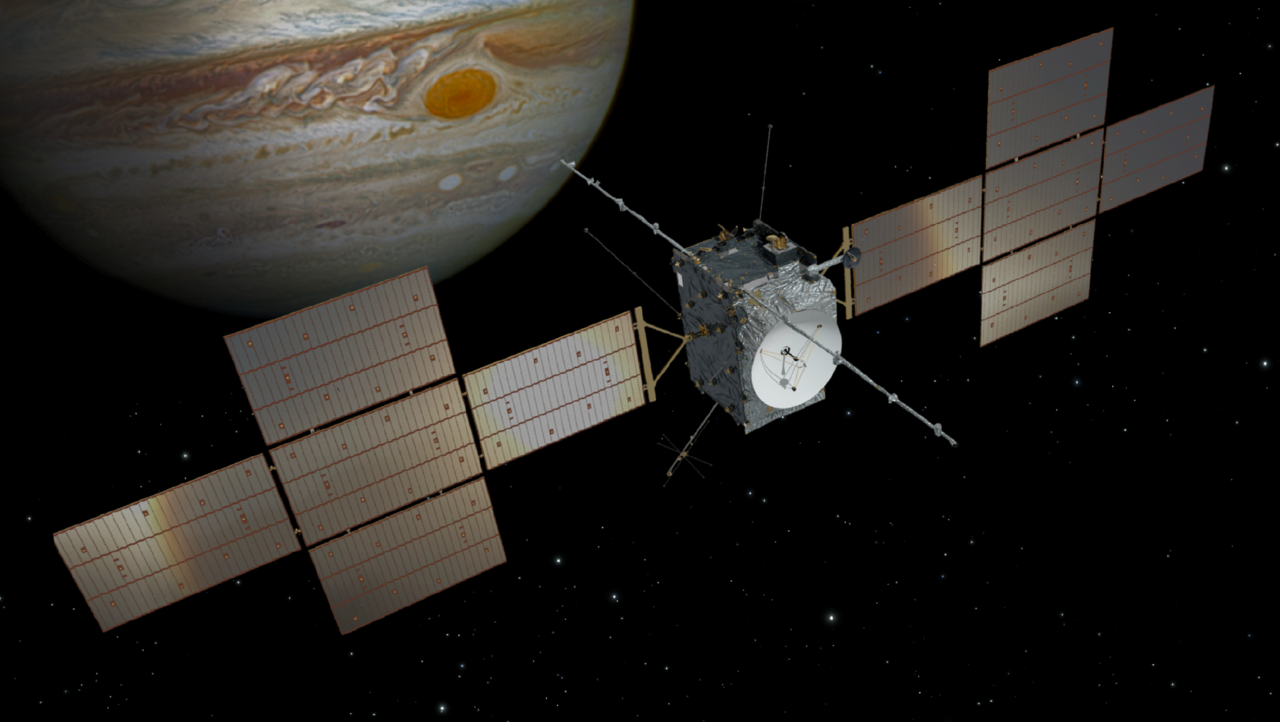
JUICE Mission: Uncovering Habitable Oceans on Jupiter's Moons
In humanity's perennial quest for life beyond Earth, one of the most compelling frontiers lies within our own cosmic backyard: the enigmatic icy moons orbiting Jupiter. These distant worlds, shrouded in thick shells of ice, are believed to harbor vast liquid water oceans beneath their surfaces, potentially offering the perfect conditions for life to emerge. Leading the charge to investigate these tantalizing possibilities is the European Space Agency's (ESA) ambitious program, the Jupiter Icy Moons Explorer, affectionately known as JUICE.
Launched with great anticipation, the JUICE mission is not just another space probe; it represents a monumental leap in our understanding of planetary systems. It's the first ESA mission destined for the outer Solar System and, remarkably, the first spacecraft ever designed to orbit a moon other than our own. Its primary objective? To conduct an in-depth study of Jupiter and three of its largest moons—Ganymede, Europa, and Callisto—to assess their habitability potential and unravel the mysteries of the Jovian system.
The Quest for Subsurface Oceans: Europa, Ganymede, and Callisto
The allure of Jupiter's icy moons stems from compelling scientific evidence suggesting they possess significant bodies of liquid water hidden beneath their frozen crusts. This water, warmed by tidal forces from Jupiter's immense gravity, represents a crucial ingredient for life as we know it.
- Europa: Often considered one of the most promising candidates for extraterrestrial life in our Solar System, Europa is thought to conceal a salty ocean twice the volume of all Earth's oceans combined. Evidence from previous missions, like Galileo, points to geysers erupting from its surface, hinting at an active internal ocean interacting with the surface.
- Ganymede: The largest moon in the entire Solar System, Ganymede is unique for having its own magnetic field, a characteristic typically associated with planets. Scientists believe this magnetic field is generated by a convection process within its deep, subsurface saltwater ocean, which might even be layered between ice sheets.
- Callisto: While less tidally active than Europa and Ganymede, Callisto also shows signs of a subsurface ocean. Its heavily cratered surface suggests a more ancient, geologically quiet past, but the potential presence of liquid water still makes it a fascinating target for habitability studies.
The JUICE mission will employ a sophisticated suite of instruments to probe these subsurface realms, looking for answers to fundamental questions: How deep are these oceans? What is their composition? Do they interact with a rocky core, potentially providing chemical energy for life? Understanding these factors is paramount to assessing whether these distant worlds could harbor microbial ecosystems, much like the chemosynthetic communities thriving around hydrothermal vents in Earth's deep oceans.
A Grand Tour: JUICE's Epic Journey to the Jovian System
The journey to Jupiter is no small feat. The Jupiter Icy Moons Explorer embarked on its epic voyage on April 14, 2023, launched aboard an Ariane 5 rocket from Europe's Spaceport in Kourou, French Guiana. This marked the beginning of an approximately eight-year cruise phase, meticulously planned to harness the gravitational pull of multiple celestial bodies to slingshot the spacecraft towards its ultimate destination.
JUICE's trajectory is a masterpiece of orbital mechanics, involving several gravity-assist maneuvers:
- A lunar-Earth flyby in August 2024
- A Venus flyby in August 2025
- Two more Earth flybys in September 2026 and January 2029
These intricate dance steps with planets and moons provide the necessary velocity boost and trajectory adjustments, significantly reducing the fuel requirements for the mission. It's a testament to human ingenuity in navigating the vastness of space, preparing the spacecraft for its arrival at Jupiter in July 2031. During its Venus flyby in late August 2025, JUICE successfully navigated an onboard anomaly, confirming the operational status of its crucial RIME instrument – a vital component for peering beneath the icy crusts of the moons. For more details on the spacecraft's journey and future flybys, you can track its progress in ESA's JUICE: Tracking the Groundbreaking Journey to Outer Planets.
Upon arrival, JUICE will perform approximately 35 close flybys of the icy moons, gathering invaluable data during these fleeting encounters. The mission culminates in December 2034, when JUICE will achieve an unprecedented feat: entering orbit around Ganymede. This will be the first time any spacecraft has ever orbited a moon other than Earth's, allowing for dedicated, long-term, close-up study of this fascinating world until at least September 2035.
Unveiling the Secrets: JUICE's Cutting-Edge Scientific Payload
To fulfill its ambitious objectives, the Jupiter Icy Moons Explorer is equipped with a formidable array of 10 state-of-the-art scientific instruments, complemented by the PRIDE radio science experiment. This diverse payload, which includes contributions from NASA and JAXA, is designed to conduct comprehensive remote sensing and in-situ measurements, providing an unprecedented view of the Jovian system:
- JANUS (JUpiter ANd moonS camera): A high-resolution optical imager that will map the surfaces of the moons, revealing their geological features, impact craters, and potential cryovolcanic activity.
- MAJIS (Moons And Jupiter Imaging Spectrometer) & SWI (Sub-millimetre Wave Instrument): These spectrometers will analyze the composition of the moons' surfaces and exospheres, identifying minerals, ice types, and even searching for organic molecules.
- GALA (GAnymede Laser Altimeter): This instrument will precisely measure the topography of the moons, providing detailed elevation maps and helping to understand their geological evolution and crustal deformation.
- RIME (Radar for Icy Moons Exploration): Perhaps one of the most critical instruments for the habitability quest, RIME is a radar sounder designed to penetrate the icy crusts, allowing scientists to map the subsurface structure, including the depth and extent of hidden oceans. Imagine using radar to see through miles of ice – that's RIME's power!
- J-MAG (JUICE MAGnetometer): Essential for studying Ganymede's unique magnetic field, J-MAG will also probe the magnetospheres of Europa and Callisto, helping to understand how they interact with Jupiter's powerful magnetic environment.
- PEP (Particle Environment Package) & RPWI (Radio & Plasma Wave Instrument): These instruments will characterize the plasma and particle environments around Jupiter and its moons, crucial for understanding the intense radiation belts and their effects on potential life.
This comprehensive suite of tools will allow JUICE to assess the moons' subsurface oceans, icy surfaces, and geological evolution with unparalleled detail. Furthermore, it will probe Jupiter's atmosphere, magnetosphere, and its intricate interactions with its satellites, providing a holistic view of this fascinating planetary system. For a deeper dive into how these instruments will unravel the secrets of these icy worlds, check out Exploring Ganymede, Europa, Callisto: The JUICE Mission's Quest.
Beyond Jupiter: The Broader Implications for Astrobiology and Planetary Science
The JUICE mission's impact extends far beyond the immediate study of Jupiter's moons. As the largest planet in our Solar System, Jupiter serves as an archetype for gas giants, offering invaluable insights into planetary formation processes and the evolution of massive worlds. By studying its complex environment, scientists can better understand similar exoplanetary systems, many of which also feature giant planets and potentially ocean-bearing moons.
Moreover, JUICE works in tandem with other missions, notably NASA's Europa Clipper, which launched in October 2024. This collaborative approach provides overlapping and complementary data on the Jovian icy worlds, maximizing our collective understanding of habitability within our Solar System. JUICE's unique ability to orbit Ganymede will provide long-term observations that Europa Clipper's flyby-centric mission cannot, offering a more complete picture.
The mission's flexibility also allows for opportunistic science; in November 2025, JUICE is scheduled to observe the interstellar comet 3I/ATLAS using its cameras, spectrometers, and particle sensors. Such observations offer a rare chance to study material from outside our Solar System, adding another layer to JUICE's scientific contributions.
The data collected by the Jupiter Icy Moons Explorer will not only inform our search for life but also deepen our comprehension of the fundamental conditions required for planets and moons to become habitable. It's a mission that will shape our understanding of where life might exist, both within our cosmic neighborhood and among the myriad stars beyond.
The JUICE mission stands as a testament to international collaboration and human curiosity. As it journeys through the vastness of space, its instruments are poised to unlock the profound secrets hidden beneath the icy surfaces of Jupiter's moons. The potential discovery of extant or past life, or even just confirming the widespread presence of liquid water, would redefine our understanding of habitability and our place in the universe, igniting a new era of astrobiological exploration. The wait until 2031 for its arrival may seem long, but the scientific bounty promised by this ambitious endeavor will undoubtedly be worth every moment.