ESA's JUICE: Tracking the Groundbreaking Journey to Outer Planets
The cosmos holds countless mysteries, but few are as captivating as the potential for life beyond Earth. At the forefront of this profound quest is the European Space Agency's (ESA) ambitious mission: the
Jupiter Icy Moons Explorer, affectionately known as JUICE. Launched in April 2023, this interplanetary spacecraft embarks on an epic eight-year voyage to the Jovian system, aiming to unlock the secrets of Jupiter and its three enigmatic ocean-bearing moons – Ganymede, Callisto, and Europa. This mission isn't just about exploring distant worlds; it's about pushing the boundaries of human understanding, investigating whether conditions favorable for life exist beneath their frozen shells, and offering unprecedented insights into the formation and evolution of gas giants and their satellite systems.
The Grand Pursuit: Unveiling Ocean Worlds
The primary scientific objective of the
Jupiter Icy Moons Explorer is to conduct detailed studies of Ganymede, Callisto, and Europa. What makes these celestial bodies so compelling? Scientists believe they harbor vast oceans of liquid water beneath their thick icy crusts. On Earth, liquid water is the fundamental prerequisite for life as we know it, making these moons prime candidates in the search for extraterrestrial habitability.
*
Ganymede: The largest moon in the Solar System, even bigger than the planet Mercury, Ganymede is unique among moons for having its own intrinsic magnetic field, suggesting a dynamic interior. JUICE is set to become the first spacecraft to orbit an outer Solar System moon other than Earth's own, offering an unparalleled opportunity to study Ganymede's geology, magnetic field, and potential subsurface ocean in exquisite detail.
*
Europa: Already a subject of intense scientific interest, Europa is believed to harbor a subsurface ocean that interacts with a rocky core, potentially leading to hydrothermal activity. While NASA's Europa Clipper mission, launched in October 2024, is primarily focused on Europa, JUICE will provide crucial overlapping data, performing multiple close flybys to complement our understanding of this tantalizing world.
*
Callisto: Often described as a "fossil world" due to its heavily cratered, ancient surface, Callisto's subsurface ocean is thought to be deeper and less interactive with a silicate core than Europa's. JUICE's investigations will help characterize its internal structure and the processes that have shaped its long history.
Beyond the moons, JUICE will also scrutinize Jupiter itself. As the largest planet in our solar system and an archetype for gas giants, Jupiter plays a pivotal role in understanding planetary formation processes and the emergence of habitable environments in diverse planetary systems, including those beyond our own. The mission will explore Jupiter's complex magnetic environment, its turbulent atmosphere, and its intricate interactions with its numerous satellites. For a deeper dive into the mission's focus on potential life, you can explore
JUICE Mission: Uncovering Habitable Oceans on Jupiter's Moons.
A Symphony of Science: Instruments and Innovation
To achieve its ambitious goals, the
Jupiter Icy Moons Explorer is equipped with a sophisticated suite of 10 state-of-the-art scientific instruments, complemented by the PRIDE radio science experiment. This impressive payload allows for comprehensive remote sensing and in-situ measurements, probing everything from the moons' surface composition to the depths of their subsurface oceans and Jupiter's magnetosphere.
Here are just a few examples of the cutting-edge technology onboard:
*
JANUS (JUpiter ANalysis and VISualisation camera): An optical imager to map the surfaces of the moons at high resolution.
*
RIME (Radar for Icy Moons Exploration): A radar sounder designed to penetrate the icy crusts and measure the thickness of the ice and the presence of liquid water beneath. This instrument is crucial for directly detecting those elusive subsurface oceans.
*
J-MAG (JUICE Magnetometer): Essential for studying Ganymede's intrinsic magnetic field and the complex interactions within Jupiter's powerful magnetosphere.
*
MAJIS (Moons And Jupiter Imaging Spectrometer) & SWI (Submillimetre Wave Instrument): These spectrometers will analyze the composition of the moons' surfaces, atmospheres, and Jupiter's atmospheric layers.
*
GALA (Ganymede Laser Altimeter): To precisely measure the topography of Ganymede's surface and detect tidal flexing, which could provide clues about its internal ocean.
*
PEP (Particle Environment Package) & RPWI (Radio and Plasma Wave Instrument): These instruments will study the plasma and particle environment around Jupiter and its moons, crucial for understanding space weather and radiation hazards.
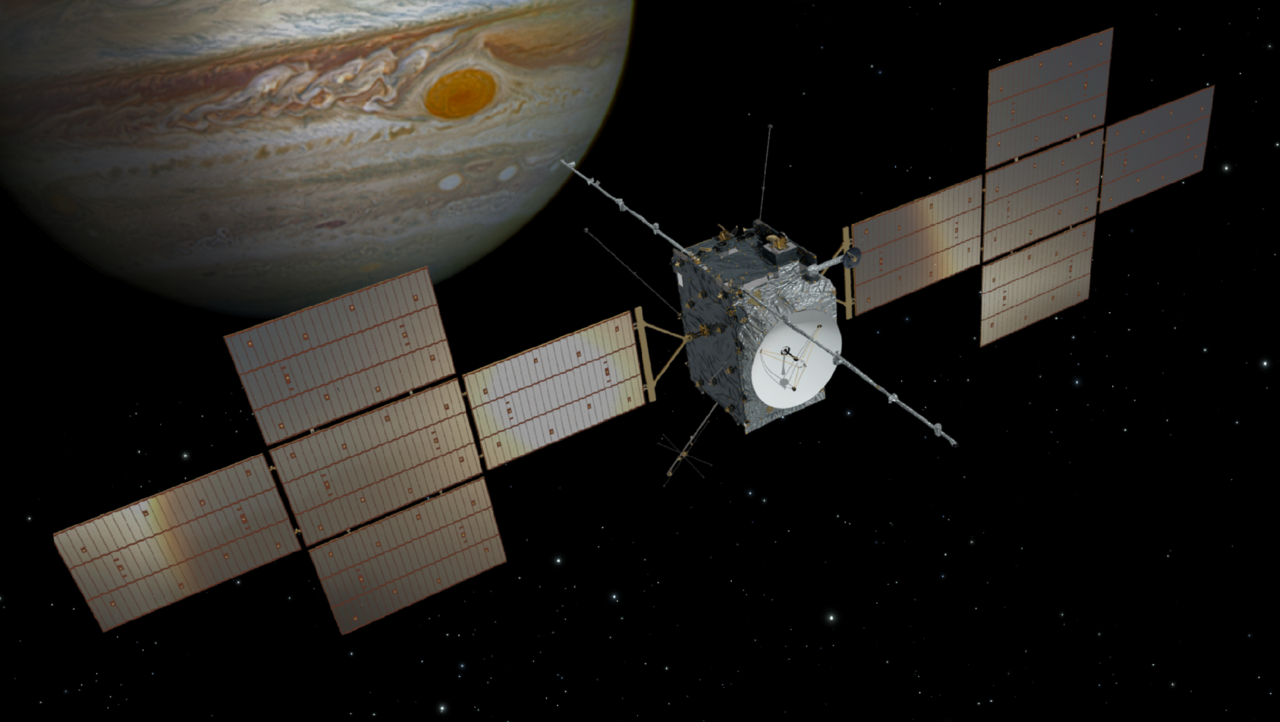
The spacecraft itself is a marvel of engineering, with a wet mass of approximately 6,000 kg. Powering this distant explorer are expansive solar arrays spanning about 85 square meters – roughly the size of a tennis court. These enormous panels are vital for generating sufficient electricity in the dim, distant reaches of the outer Solar System. The mission is a testament to international collaboration, led by ESA, with significant contributions from NASA (including the ultraviolet spectrometer and hardware for other payloads) and JAXA (components for several instruments).
The Odyssey to Jupiter: Milestones and Maneuvers
The journey of the
Jupiter Icy Moons Explorer is an epic in itself, requiring an intricate sequence of gravity-assist maneuvers to gain the necessary speed and trajectory to reach Jupiter. Launched on April 14, 2023, aboard an Ariane 5 rocket from Europe's Spaceport in Kourou, French Guiana, JUICE began its arduous cruise phase.
Here are the key milestones on its path:
*
August 2024: A crucial lunar-Earth flyby.
*
August 2025: A Venus flyby, during which an onboard anomaly was successfully resolved, and the RIME instrument was confirmed operational. This maneuver also allowed for opportunistic observations of the interstellar comet 3I/ATLAS later in November 2025, demonstrating the mission's adaptability and scientific breadth.
*
September 2026: Another Earth flyby.
*
January 2029: A final Earth flyby to slingshot the spacecraft towards its ultimate destination.
*
July 2031: Arrival at Jupiter, marking the beginning of its four-year science phase.
Upon arrival, the spacecraft will embark on a series of approximately 35 close flybys of Ganymede, Europa, and Callisto. These intricate orbital dance maneuvers are designed to gather as much data as possible from varying perspectives. The culmination of this phase will see JUICE perform a final, unique maneuver: entering orbit around Ganymede in December 2034. It will remain in orbit for dedicated close-up study until at least September 2035, making it the first spacecraft in history to orbit a moon other than Earth's own in the outer Solar System. For a detailed look at the journey and targets, read
Exploring Ganymede, Europa, Callisto: The JUICE Mission's Quest.
Why JUICE Matters: A New Era of Exploration
The
Jupiter Icy Moons Explorer represents a monumental leap in humanity's quest to understand our place in the universe. Its findings will not only reshape our knowledge of the Jovian system but also have profound implications for astrobiology and the broader search for life beyond Earth. By studying these potential ocean worlds, we gain insights into the conditions under which life can arise and thrive, broadening our perspective on what "habitable" truly means.
Moreover, JUICE complements other ongoing and planned missions, such as NASA's Europa Clipper. The combined data from these missions will provide an unprecedented, multi-faceted view of Jupiter's icy moons, allowing scientists to cross-reference observations and build a more complete picture of these complex environments. The successful resolution of the onboard anomaly during the Venus flyby in 2025 also serves as a testament to the resilience and ingenuity of the mission teams, highlighting the challenges and triumphs inherent in deep space exploration.
This mission will also serve as a crucial analog for understanding extrasolar planetary systems. Many exoplanets discovered are gas giants, and studying Jupiter and its moons in such detail can offer invaluable insights into how similar systems might form and evolve around other stars. For those eager to follow this incredible journey, official updates, images, and scientific papers are regularly released by ESA and its partners, offering a fantastic opportunity to stay connected with the ongoing exploration of our solar system.
In essence, JUICE is more than just a spacecraft; it's a testament to human curiosity, engineering prowess, and the enduring dream of discovering life beyond our home planet. As it cruises toward the outer Solar System, the anticipation for its arrival and the data it will send back only continues to grow.
Conclusion
The
Jupiter Icy Moons Explorer stands as a beacon of ambitious space exploration. As it traverses the vast expanse between Earth and Jupiter, it carries with it the hopes of scientists and enthusiasts alike, eager to peer beneath the icy veils of Ganymede, Callisto, and Europa. Its groundbreaking capabilities, long journey, and unique mission profile – including being the first spacecraft to orbit a moon in the outer Solar System – underscore its significance. The insights gleaned from JUICE will not only inform our understanding of the Jovian system as a potential cradle for life but also profoundly influence our perspective on planetary habitability throughout the cosmos, ushering in a new era of discovery.