Exploring Ganymede, Europa, Callisto: The JUICE Mission's Quest
In the vast expanse of our solar system, few destinations captivate the scientific community quite like Jupiter and its entourage of enigmatic moons. Among these, three stand out as prime targets in the ongoing quest for extraterrestrial life: Ganymede, Europa, and Callisto. It is to these icy behemoths that the European Space Agency (ESA) has dispatched its most ambitious interplanetary mission to date, the Jupiter Icy Moons Explorer, affectionately known as JUICE.
Launched in April 2023, JUICE embarks on an eight-year odyssey to unravel the mysteries of these planetary-mass moons. Scientists believe that beneath their frozen crusts lie vast, deep oceans of liquid water – a fundamental ingredient for life as we know it. This makes them compelling candidates for harboring microbial life, both past and present. The mission represents a groundbreaking achievement for European space exploration, being the first interplanetary spacecraft to the outer Solar System planets not launched by the United States and the first set to orbit a moon other than Earth's. As a crucial component of ESA's Cosmic Vision 2015–2025 program, the JUICE Mission is set to uncover habitable oceans on Jupiter's moons, providing unprecedented insights into the potential for life beyond Earth.
The Allure of Jupiter's Icy Worlds: Ganymede, Europa, and Callisto
Each of JUICE's target moons presents a unique set of characteristics that make them fascinating subjects of study:
- Ganymede: The largest moon in the entire solar system, even bigger than the planet Mercury, Ganymede is unique among moons for possessing its own intrinsic magnetic field. This suggests a differentiated interior with a liquid iron core. Evidence strongly indicates a massive subsurface ocean, potentially sandwiched between layers of ice. JUICE will make history by becoming the first spacecraft to enter orbit around Ganymede, allowing for dedicated, close-up study of its geology, magnetosphere, and the interaction of its ocean with the surface.
- Europa: Often considered the most promising candidate for current life in our solar system, Europa is renowned for its smooth, cracked icy surface, hinting at dynamic processes beneath. Observations by the Galileo spacecraft have suggested the presence of plumes erupting from its surface, potentially indicative of hydrothermal activity within its ocean – a key ingredient for supporting life. While JUICE will not orbit Europa, it will conduct multiple close flybys, complementing the dedicated studies by NASA's Europa Clipper mission. These flybys will provide crucial data on Europa's ice shell, ocean properties, and potential eruptive activity.
- Callisto: In stark contrast to its more active siblings, Callisto is a heavily cratered, geologically ancient world. Despite its seemingly dormant appearance, scientists still believe it harbors a deep subsurface ocean. Studying Callisto provides a vital comparative perspective. Its relatively undisturbed surface can offer clues about the early history of the Jovian system, while its potential ocean, if confirmed, would challenge our understanding of what conditions are necessary for liquid water to persist for billions of years.
The shared characteristic of these moons – the probable presence of significant bodies of liquid water beneath their frozen surfaces – is what fuels the ESA's JUICE mission, tracking its groundbreaking journey to outer planets. Scientists will search for signs of a habitable environment, focusing on the presence of liquid water, an energy source (such as hydrothermal vents), and the necessary chemical building blocks for life.
Unveiling JUICE: A Technological Marvel on a Grand Quest
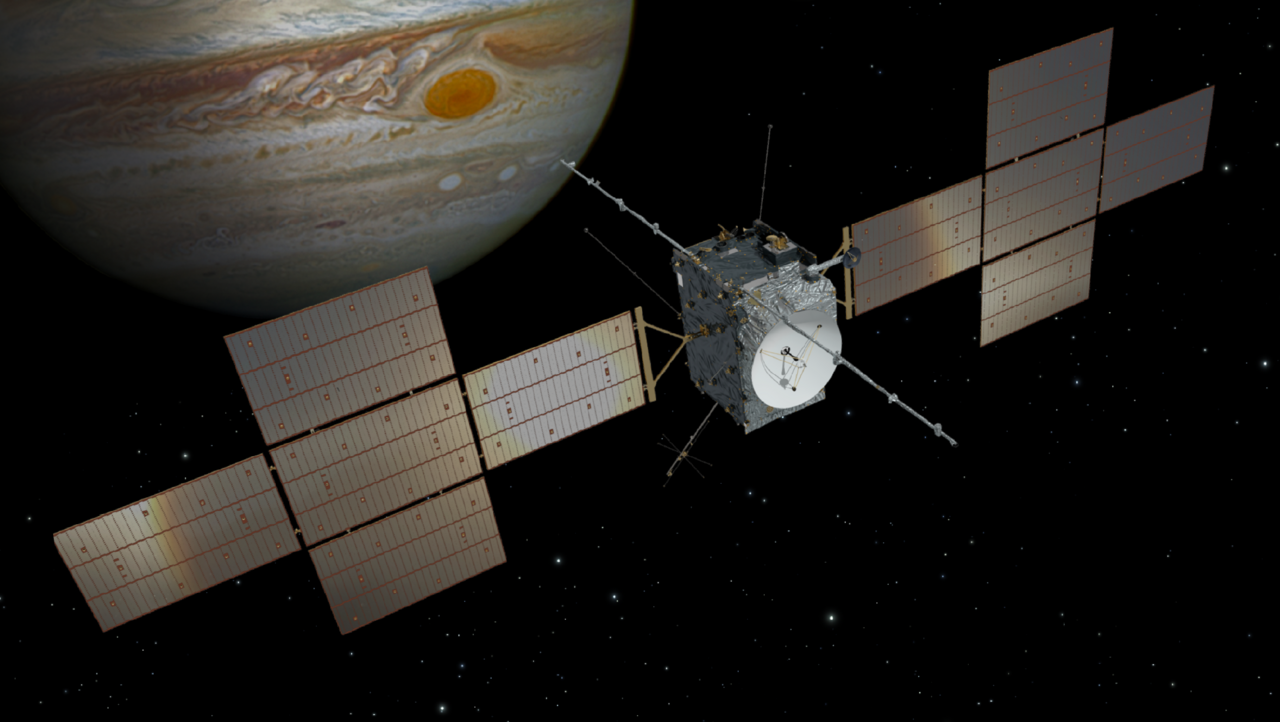
The Jupiter Icy Moons Explorer is not merely a spacecraft; it is a sophisticated mobile laboratory designed to operate in the harsh environment of the outer solar system. This mission showcases the power of international collaboration, with significant contributions from NASA and JAXA complementing ESA's leadership.
Weighing approximately 6,000 kg (wet mass) at launch, JUICE carries an impressive suite of 10 state-of-the-art scientific instruments, alongside the PRIDE radio science experiment. These instruments enable comprehensive remote sensing and in-situ measurements:
- Optical Imagers (JANUS) and Spectrometers (MAJIS, SWI): To map the moons' surfaces, analyze their composition, and study their atmospheres.
- Laser Altimeter (GALA) and Radar (RIME): RIME, in particular, is crucial for peering through kilometers of ice to characterize the subsurface oceans and the structure of the ice shells. The successful confirmation of RIME's operation after an onboard anomaly during its Venus flyby was a significant milestone.
- Magnetometer (J-MAG): Essential for detecting and characterizing the magnetic fields induced by subsurface oceans, providing definitive evidence of their existence and properties.
- Particle Detectors (PEP) and Radio/Wave Analyzers (RPWI): To study Jupiter's complex magnetosphere and its interactions with the moons, which play a critical role in their environments.
Powering this array of instruments during its long cruise and intense science phase requires expansive solar arrays, spanning about 85 m², designed to capture sunlight even at Jupiter's distant orbit. This engineering marvel underscores the challenges and innovations required for exploring the outer Solar System.
The Scientific Imperatives: What JUICE Hopes to Discover
The primary objectives of the Jupiter Icy Moons Explorer are multi-faceted, aiming to address some of the most profound questions in planetary science:
- Characterizing Subsurface Oceans: The mission will seek to confirm the existence, size, depth, and salinity of these hidden oceans. Instruments like RIME will be vital for profiling the ice shells, while J-MAG will look for induced magnetic fields that are tell-tale signs of vast liquid conductors. Understanding these oceans is fundamental to assessing their potential for habitability.
- Geological Evolution and Dynamics: By studying the surfaces and interiors of Ganymede, Europa, and Callisto, JUICE will shed light on their formation mechanisms and how they have evolved over billions of years. Comparing the highly active Europa with the more static Callisto will provide crucial insights into the factors that drive geological activity on icy worlds.
- Jupiter as an Archetype: The mission extends beyond the moons to include a detailed study of Jupiter itself. As the largest planet in our solar system and an archetype for gas giants found around other stars, Jupiter offers clues about planetary formation processes and the broader dynamics of giant planet systems. JUICE will investigate Jupiter's atmosphere, magnetosphere, and its profound influence on its satellites.
- Search for Habitability: Ultimately, JUICE's quest is intertwined with humanity's age-old desire to find life beyond Earth. By thoroughly characterizing the environments of these icy moons, the mission will help scientists understand the conditions necessary for life to emerge and thrive, guiding future missions that may search for direct biosignatures.
Understanding these fundamental processes not only satisfies our curiosity about our own cosmic neighborhood but also provides invaluable context for the ever-growing number of exoplanets discovered, helping us narrow down the search for life in the galaxy.
Navigating the Cosmos: JUICE's Grand Tour
The journey to Jupiter is a marathon, not a sprint. The Jupiter Icy Moons Explorer embarked on a complex trajectory involving multiple gravity-assist maneuvers, which use the gravitational pull of planets to slingshot the spacecraft towards its destination, saving immense amounts of fuel.
- Lunar-Earth Flyby: August 2024
- Venus Flyby: August 2025 – a critical milestone where an onboard anomaly was successfully resolved, and the RIME instrument was confirmed operational.
- Earth Flybys: September 2026 and January 2029
Following these intricate celestial dances, JUICE is scheduled to arrive at Jupiter in July 2031, initiating a four-year science phase. During this period, the spacecraft will perform approximately 35 close flybys of the icy moons, including multiple encounters with Europa and Callisto. The culmination of the mission will see JUICE enter orbit around Ganymede in December 2034, a first for any spacecraft around a non-Earth moon. It will continue its dedicated close-up study until at least September 2035. As an exciting bonus, the mission is also planned to conduct opportunistic observations of the interstellar comet 3I/ATLAS in November 2025, using its advanced cameras, spectrometers, and particle sensors.
Conclusion
The Jupiter Icy Moons Explorer represents a bold leap in humanity's quest to understand the universe and our place within it. By meticulously studying Ganymede, Europa, and Callisto, JUICE promises to transform our understanding of potentially habitable environments beyond Earth. The mission's findings will not only deepen our knowledge of the Jovian system but also inform the broader search for life in extrasolar planetary systems. As JUICE continues its long voyage, the anticipation builds for the groundbreaking discoveries that await, poised to rewrite textbooks and inspire generations with the wonders of our solar system's icy frontiers.